Thanks to the Innovation Chairs created in 2022, I will be able to focus on the development and industrialization of Architectured Materials using the ASLM technology developed at TETMET.
I’m fully indebted to my family, friends, and colleagues for support over the years, and of course to my former and current students, as well as the whole TETMET team for getting the work done!
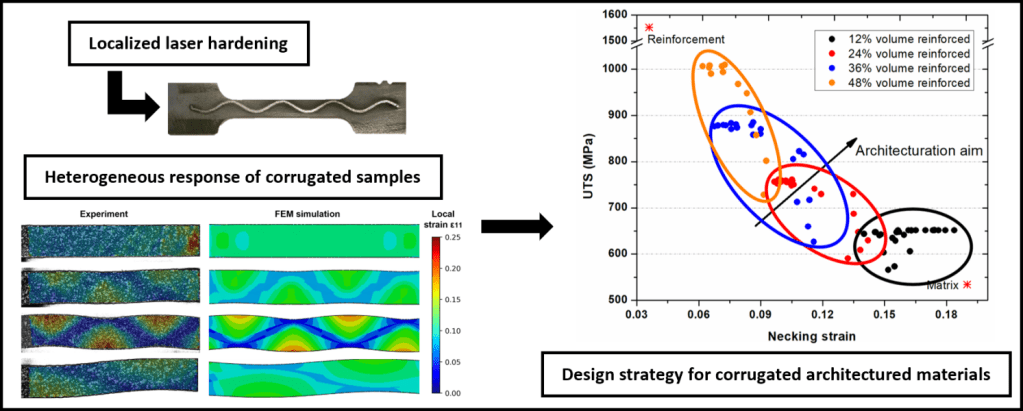
Science takes time, a lot of time. Our last paper just got published (https://doi.org/10.1002/srin.202200695) in Steel Research International , it might seem like just another scientific paper that no one will read, and most likely it will be true, but this paper does have a special meaning for me as a scientist.
Its inception dates back 10 years ago when I was starting out as an academic. I had this idea that we could look into laser processing for creating architectured materials, i.e. materials with behavior primarily driven by geometry, based on a paper by Olivier Bouaziz (https://doi.org/10.1016/j.scriptamat.2012.08.008).
It only took 3 attempts at ANR, the French National Research Agency annual call of proposals to get funded (https://anr.fr/Projet-ANR-16-CE08-0009), gathering a wonderful team of young researchers and colleagues over the years, 3 prior papers on the processing method and metallurgical characterization, and a lot of pugnacity (special thanks to Zhige Wang and Pierre Lapouge) to finally reach our initial goal, which was to experimentally demonstrate the possibility of obtaining architecturation effects using a single sheet of steel and one (or two!) laser. We finally did it and it feels good to have reach this milestone, although it might seem like a very small step from the outside. This result opens many routes for new research and industrial applications, with benefits like frugal material processing, relocating steel production, recycling, and material-by-design steel. The paper is published in open access so that anybody can learn more about laser architecturation of steel sheets.
Our latest paper in International Journal of Solids and Structures deals with harnessing material instabilities through inner material architecture, here in the case of 2D planar lattices. ( https://doi.org/10.1016/j.ijsolstr.2020.05.027 )
These results are the work of Antoine-Emmanuel Viard, currently doing his PhD in collaboration between PIMM and Centre des Matériaux (MINES-ParisTech, PSL University) (Dr. Samuel Forest).
These results open the path for the design of architectured materials with instability-driven behavior, i.e. actuators, unfolding structures, etc., as well as bespoke materials able to accentuate or mitigate the onset and propagation of instabilities. In this work we looked specifically to Piobert-Lüders plastic instabilities, but the results will be extended to shape-memory alloys for reversible applications.
This study is funded by Agence Nationale de la Recherche through the ANR ALMARIS project (Grant No. ANR-16-CE08-0001).
In our latest paper, soon to appear in a special issue of ASME Journal of Applied Mechanics dedicated to the mechanics of architectured materials, we present new results regarding the computational modelling of 3D auxetic lattices. ( https://doi.org/10.1115/1.4044542 )
These results have been obtained by Frédéric Albertini, in collaboration between PIMM and Monash University (Dr. Andrey Molotnikov).
The auxetic effect could lead to improved mechanical properties such as acoustic damping, indentation resistance, or crashworthiness. In this work, two 3D auxetic lattices are introduced. Auxeticity is achieved by design through pre-buckling of the lattice struts. The influence of geometrical parameters on the effective elastic properties is investigated using computational homogenization method with periodic boundary conditions. Effective Young’s modulus is 3D mapped to reveal anisotropy and identify spatial orientations of interest. The effective Poisson ratio is computed for various geometric configurations to characterize auxeticity. Finally, the influence of effective elastic properties on energy dissipation under compression is explored for elastoplastic lattices with different loading directions, using finite element simulations. Results suggest that loading 3D auxetic lattices along their stiffest direction maximizes their crashworthiness.
PhD scholarship in materials science available (36 months)
An ANR-funded scholarship is available at PIMM laboratory to work on the material architecturation of metallic sheets by localized laser treatment. The successful candidate should have obtained a Master’s degree (or equivalent) with a strong background in computational mechanics, materials science, mechanical engineering or any related field; although prior knowledge of the French language is not mandatory, spoken and written English proficiency is needed. See the file attached for more information: A4 advertisement
In the past year, a new materials engineering curriculum was designed and developed at Cnam in the Paris campus. This curriculum will be supervised by Justin Dirrenberger, starting in September 2018. The program is proposed within a 3-year fully co-operative education framework, combining classical academic teaching with on-hand professional experience. More information on this program can be found in the attached documents (in French).
I was recently invited to give a keynote lecture on architectured materials within the context of EDTAS Symposium on Advanced Materials and Manufacturing, organised by the Australian Defence Science & Technology Group and the University of Melbourne. The event was live-streamed on YouTube and my presentation can be seen on the following link: https://youtu.be/DPiwN5O40YQ?t=4h38m57s
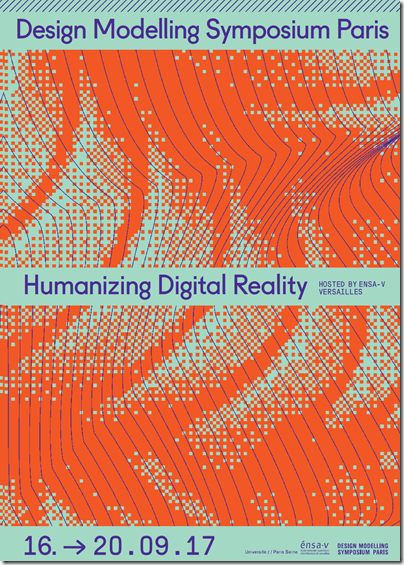
Our new paper titled Design of Space Truss Based Insulating Walls for Robotic Fabrication in Concrete as part of the Humanizing Digital Reality book. Romain Duballet has been working on the on the design of ultra-light concrete walls for individual or collective housing, the normative context being constrained masonry. A robotic manufacturing technique based on mortar extrusion that allows producing more efficient walls is used. He made use of optimisation and genetic algorithms in order to design a structure optimised for robotic construction. Romain is also a founding member of XtreeE, a startup company specialised in developing large-scale 3D printing equipment.
Our new paper titled Classification of building systems for concrete 3D printing was just published in the journal Automation in Construction. Congratulations to Romain Duballet who has been working on a classification method for building systems making use of large-scale additive manufacturing. Our aim with this paper is to set a nomenclature and classification system that will be hopefully be adopted by the scientific community in the large-scale additive manufacturing field. The classification we propose also allows to determine the minimal robotic complexity necessary for a given application. Romain is also a founding member of XtreeE, a startup company specialised in developing large-scale 3D printing equipment.
Specific parameters are highlighted – concerning scale, environment, support, and assembly strategies – and a classification method is introduced in the paper. The objective is to explicitly characterise construction systems based on 3D printing processes. A cartography of the different approaches and subsequent robotic complexity is proposed. The state of the art gathered from the literature is mapped thanks to this classification. Here is a depiction of the variations associated with the external support parameter:
Our new paper titled Isogeometric shape optimization of smoothed petal auxetic structures via computational periodic homogenization was just published in Computer Methods in Applied Mechanics and Engineering. The aim of this research is to develop and apply isogeometric analysis to the shape optimization of 2D auxetic lattice materials. This work was lead by Zhen-Pei Wang, currently an associate researcher in the group of Prof. Leong Hien Poh at National University of Singapore. This is a collaboration between NUS, Mines-ParisTech, and our group in Paris.
On the figure hereafter, subfigure a depicts 3 different cases of shape optimization with a radius of curvature constraint; subfigure b shows the polar plot of the effective in-plane Poisson ratio; subfigure c is a plot of the convergence of negative Poisson’s ratio with respect to the iteration steps of the optimization scheme.



 s Based Insulating Walls for Robotic Fabrication in Concrete as part of the
 Our new paper titled Classification of building systems for concrete 3D printing was just published in the journal
 structures via computational periodic homogenization was just published in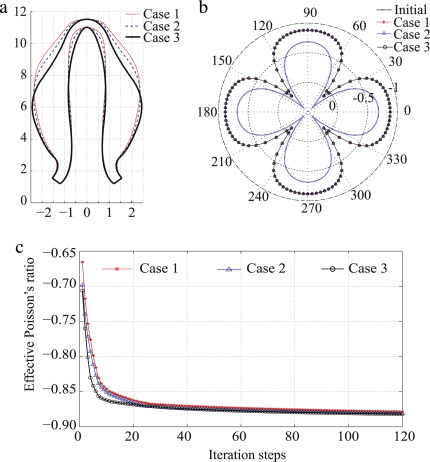
 Dirrenberger Research Group